The Butcher's (1959)
some streets never change
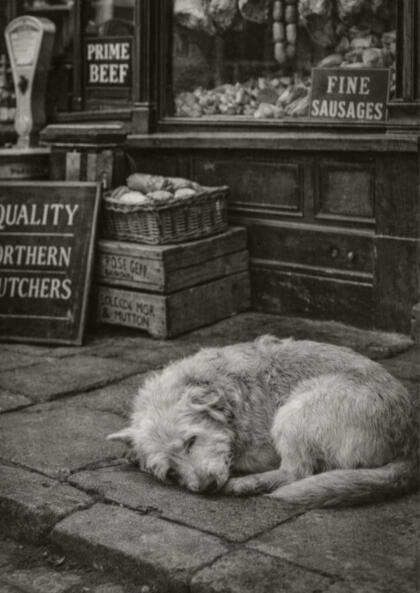
Released in autumn 1959, The Butcher’s marked the first significant critical attention received by Crimea Street Films and is often regarded as the production that established the studio’s characteristic visual style.Directed by Peter Halliday, the film centred on a declining family butcher’s shop in Bolton during a period of gradual economic change. Rather than focusing on dramatic events, the story followed the rhythms of ordinary working life: deliveries before dawn, unpaid tabs, repetitive routines and the slow disappearance of traditional high street businesses. Much of the emotional weight reportedly rested not in dialogue, but in silence, routine and the physical environment itself.The production also became quietly known for the screen debut of Lira, the large terrier-cross discovered wandering near the original filming location. According to several later interviews, Lira was not initially intended to appear prominently in the film, but Dunmore became convinced the animal reflected what he described as:“the same exhausted dignity as the street itself.”The decision resulted in several extended sequences featuring the dog lying outside the shop while daily life passed almost unnoticed around her. Contemporary critics remained sharply divided on whether these scenes were moving, indulgent or simply unnecessarily long.
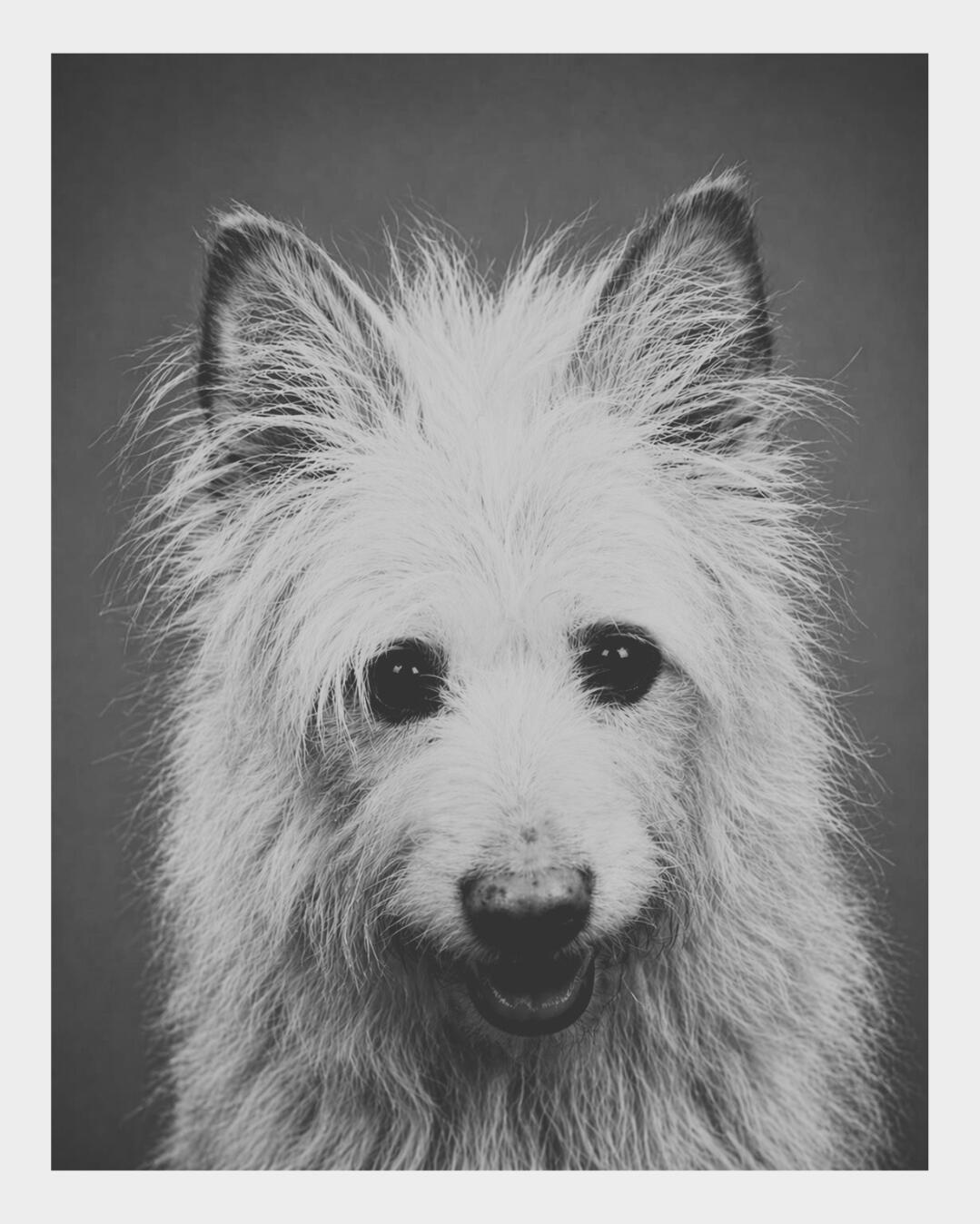
Lira (c1957–?)In early 1959, one of the many stray dogs that roamed the Salford streets started to hang around outside the studios day and night.Clearly hungry and cold, the poor animal was grateful for any scraps it was thrown and before too long was being encouraged to come inside and get warm.The dog was clearly affectionate and quickly became a favourite with everyone. She was named Lira, after someone had found an Italian Lira in their change from the fish and chip shop and everyone said it suited her.Then someone (and nobody ever agreed who) said she could be a ‘Northern Lassie’ and that’s how things spiralled.In 1959, the line ‘Introducing Lira’, appeared on ‘The Butcher’s’ promotional poster and the thinking was a new star had been born with plans for a succession of films to follow.However, it quickly became apparent that while very friendly, Lira was also not particularly bright. She only responded to her name when she felt like, she only reacted to commands when given treats and the treats would cause her to produce quite toxic gas followed by deep sleep.Although she remained a ‘star’ of the film, in reality her contribution was minimal and she was a law unto herself and more interested in belly rubs than the camera getting her best side.The general consensus was that the silver screen wasn’t for this girl but she remained a firm favourite around the studios and by 1960, one of the catering staff adopted her and took Lira to Bristol when the family relocated for personal reasons.Perhaps Lira’s destiny was never to be the new ‘Lassie’ but she escaped from the streets to live a life of comfort, so she wasn’t that stupid, was she?
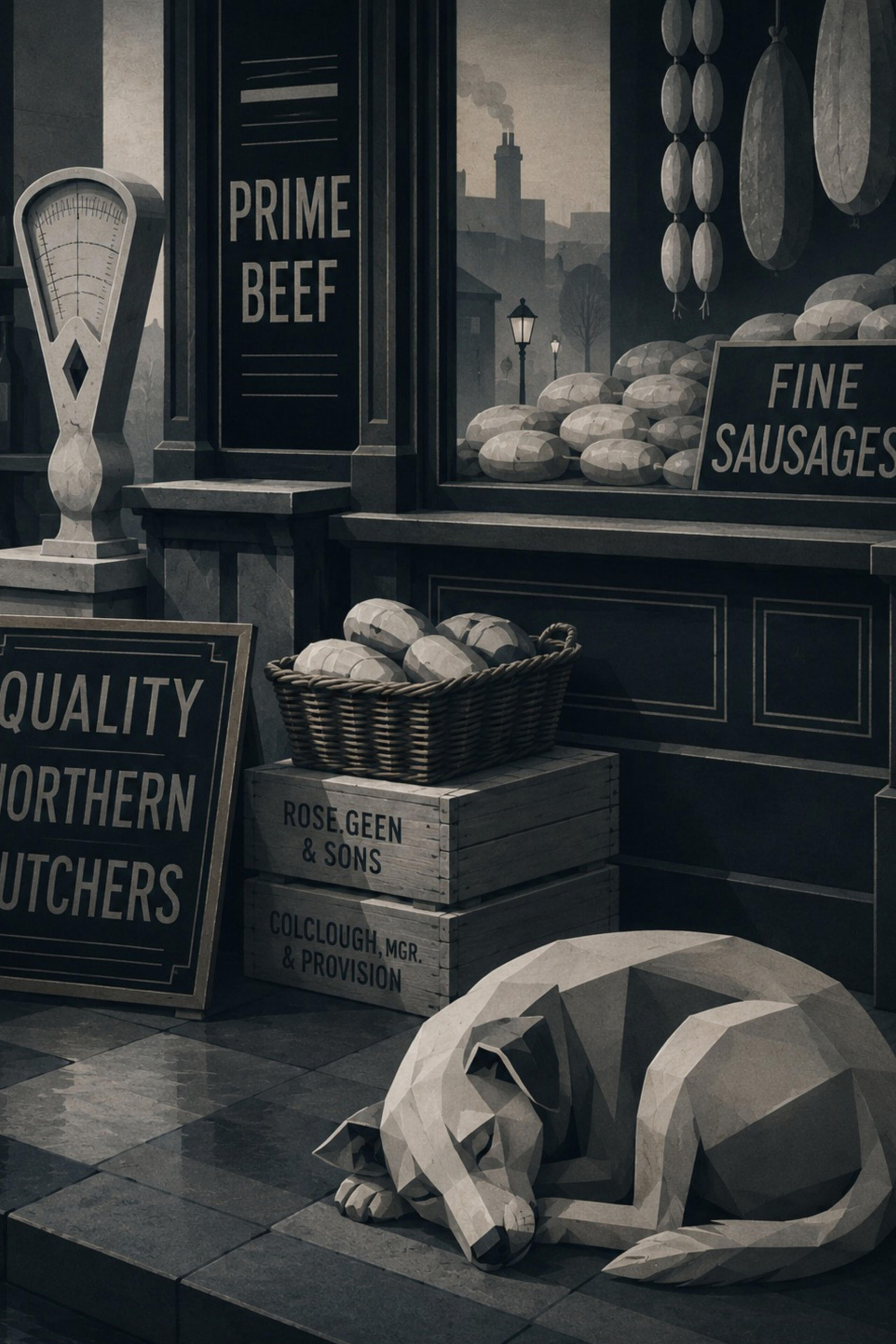
The Butchers transforms an ordinary northern shopfront into a carefully ordered composition of scales, signs, tiled surfaces and hanging produce.The sleeping dog in the foreground introduces a softer presence, while the empty street beyond gives the scene its quiet, early-morning atmosphere.Rendered in slate grey, charcoal and muted cream, the image combines the architectural precision of Art Deco illustration with the stillness of a remembered high street.Strong verticals, simplified forms and faceted surfaces give familiar details an unexpected monumentality.Available exclusively through FCSF, this artistic interpretation is available unframed on 240 gsm art paper and measures 16 x 20 inches.
What did the critics think?
The Bolton Evening News described the production as:“A strangely affecting portrait of decline in which even the dog appears burdened by industrial Britain.”While ‘Picture Weekly’ was less enthusiastic at the time commenting:“An exceptionally slow northern drama notable mainly for its atmosphere and an unusually tired-looking animal.”Despite modest box office returns, The Butcher’s attracted praise for Freddie Francis’s stark black-and-white cinematography and Johnny Dankworth’s restrained jazz score, both of which helped distinguish the production from many contemporary regional dramas.
From the archive
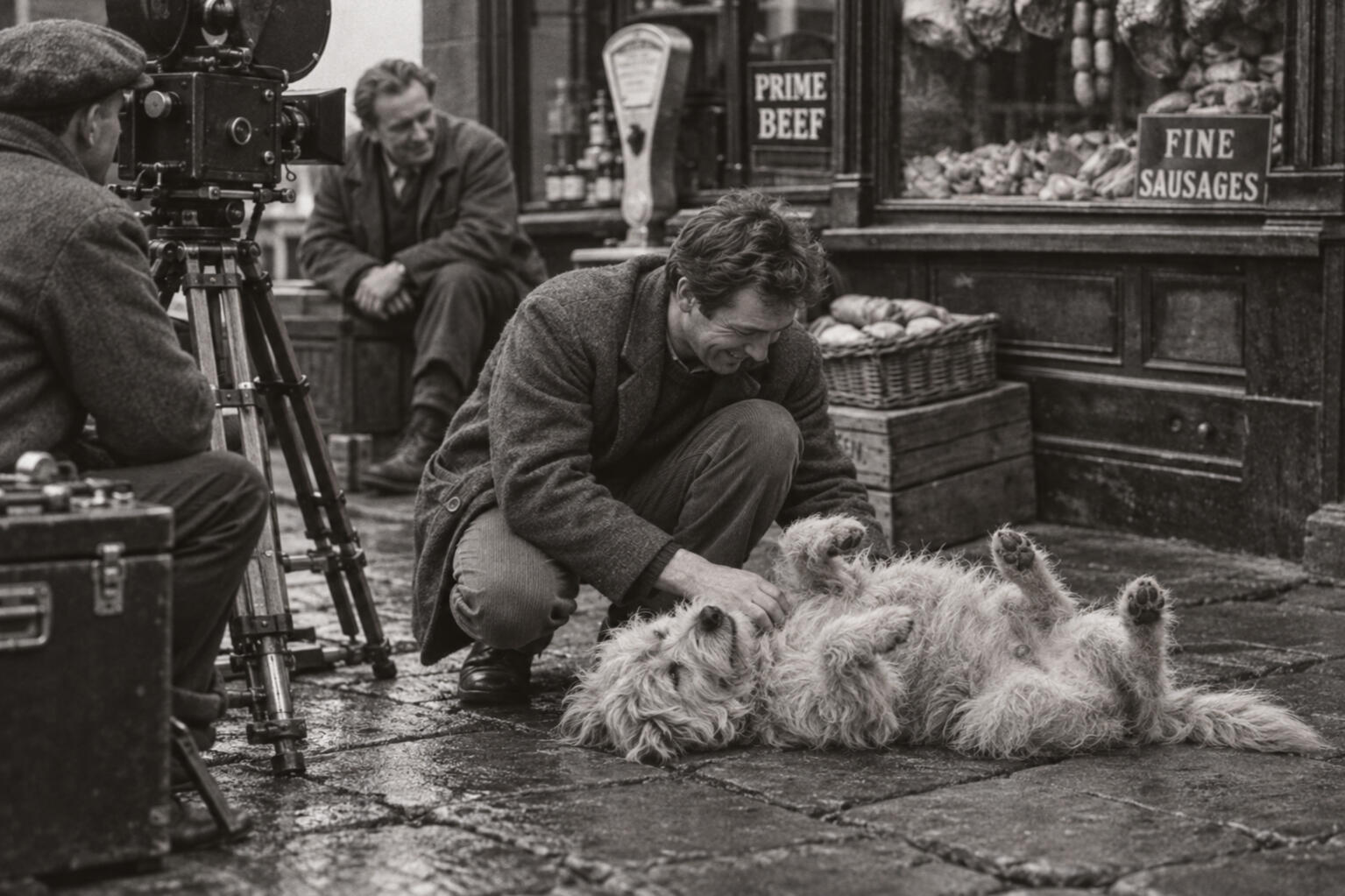
Lira put on so much weight due to treats that at one point Dunmore put a blanket ban on all pastry products on set. It didn't last long.
Publicity shot from the archive
The artwork of Reg Baines
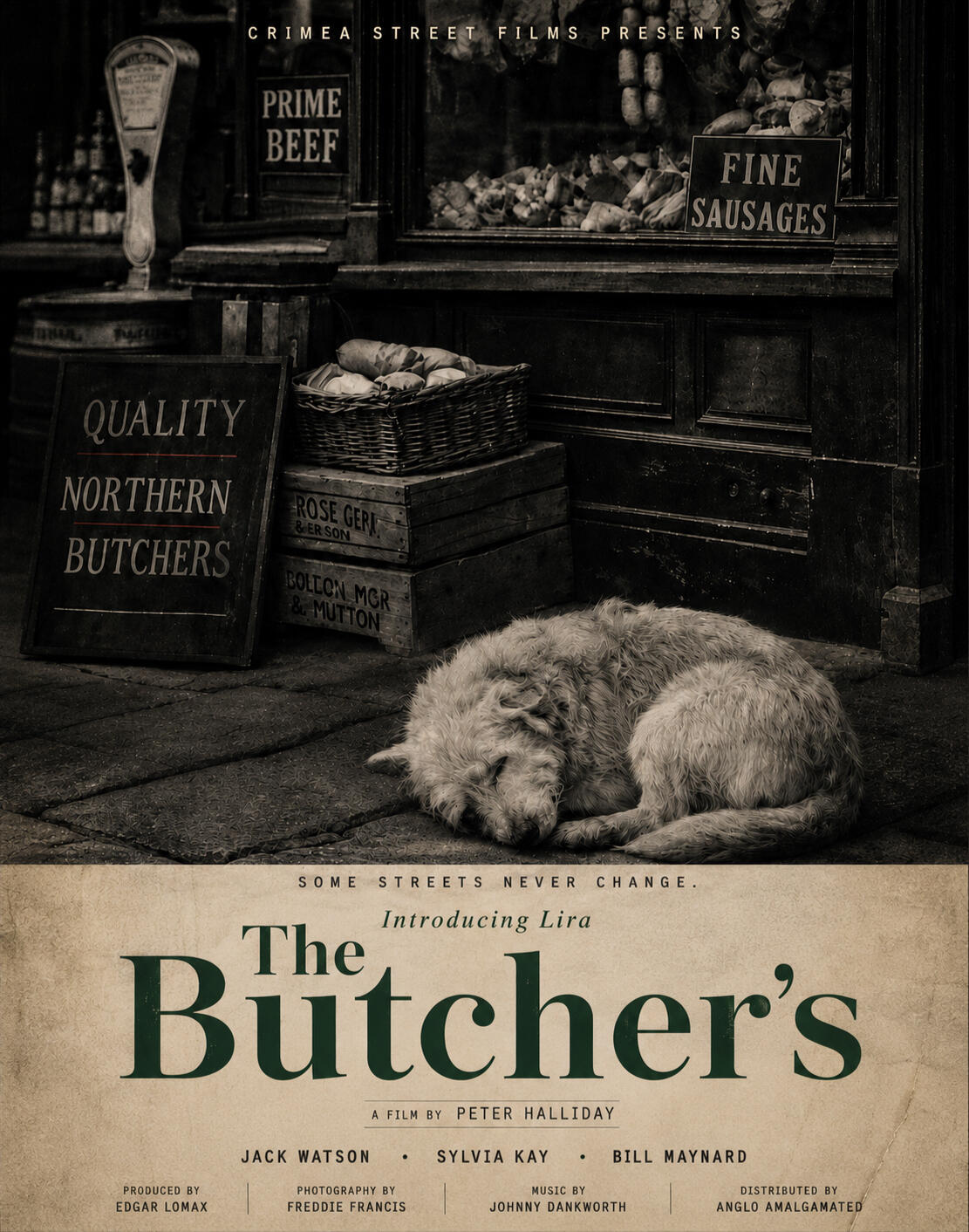
The original posters created by Reg Baines are synonymous with the studio and are very much part of its history.They would have been seen throughout the North of England outside cinemas, on hoardings and in places such as train stations.Most of them were damaged in a fire at the studio in late 1966, but we are delighted to now work with Parbold based artist, Brian Astley.He has faithfully reproduced each poster to a standard that our Reg would have been proud of and each one is available unframed on 240 gsm art paper as a 16 x 20 inch homage to the films we celebrate.